
Safety on a hack: sharing your location with people close to you
Sharing your location during a hack lets the people the rider has authorised know where the rider is. This sharing is a safety tool. Fall detection (still experimental) is a separate signal: it is not sent automatically to people close to the rider. Paddoco helps you prepare it; it does not call the emergency services for you.
Have you opened a link sent so you can follow a rider? The page for people close to the rider explains that this website does not show a location, and invites you to install Paddoco.
By the Paddoco team ·
Jump to frequently asked questions
Let people know where you are before you set off
In Hacks, prepare your ride and participants, or open the ride you have joined.
Before leaving, choose whether to follow a route or record your own. Check location permissions and the location-sharing choice for your participation.
This location sharing is offered for your participation. It lets authorised people know where you are during the ride. It is not a way to showcase a route.
Check location permissions and the sharing chosen for your participation before departure. Being a manager, administrator or travelling companion does not grant general access to other people’s private position. Fall detection (still experimental) remains an uncertain signal and depends on the network; no public emergency service is called automatically. It goes to your companions on the ride, the organiser, the yard’s authorised team and the horse’s current owners, according to the activity’s permissions. It is not sent automatically to people close to you.
Start the ride. When back, finish it and check the confirmation of your return on its record.
An offline map does not send your location
If preparing an offline map, wait for confirmation of the downloaded areas. Not every map or feature is available offline.
In an installed app, tracking also depends on phone permissions and settings. In a browser, tracking can stop when the screen locks or the app moves into the background.
Check these points before you set off if an authorised person needs to know where you are. A map already downloaded does not make location sharing or the fall alert (still experimental) available without a signal.
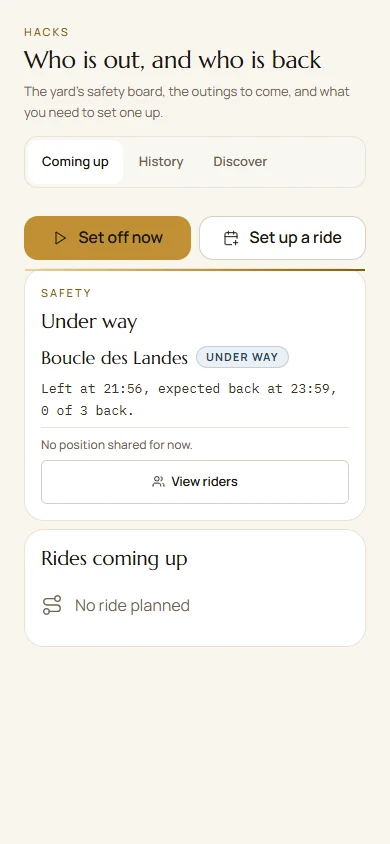
The safety board is not an emergency service
The safety board helps follow a ride; it is not an emergency service. If sending fails, keep the ride and use the retry offered.
In an emergency, contact the emergency services yourself: the board does not call them.
Respond to a possible fall alert (detection still experimental)
Before a hack or ridden session, review the available safety settings and phone permissions. Fall detection (still experimental) depends on the device and settings.
If a possible fall is reported, respond that you are safe or request help. Responding that you are safe can avoid the alert. A request for help, or no response, can produce it. The alert goes to your companions on the ride, the organiser, the yard’s authorised team and the horse’s current owners, according to the activity’s permissions. It is not sent automatically to people close to you. Those recipients see the follow-up and the contact details they are allowed to view.
This detection, still experimental, can be wrong, and the network can prevent sending. No public emergency service is called automatically: contact the emergency services yourself in an emergency.
After the ride, check what a public route reveals
In Hacks, open History and your ride. For an untracked ride, use the retrospective entry offered.
Add useful memories and choose visibility before sharing a route or photos.
A public route can reveal its start and finish. Read that choice again: it can show where you set off and where you arrive, including to people who were not on the ride.
Common questions about hack safety
What is location sharing for during a hack?
It lets the people you have authorised for your participation know where you are. It is not a way to publish a route, nor an automatic fall alert sent to people close to you. Fall detection (still experimental) is a separate signal: it goes to your companions on the ride, the organiser, the yard’s authorised team and the horse’s current owners, according to the activity’s permissions. Sharing during the ride and the visibility of a route afterwards are two separate choices.
Does the safety board alert the emergency services if I do not return?
No. The safety board helps follow a ride. It is not an emergency service, and no public emergency service is called automatically. If you need help, contact the emergency services yourself. If sending fails, keep the ride and use the retry offered.
What should you do when a possible fall is reported?
Respond that you are safe or request help. Fall detection (still experimental) goes to your companions on the ride, the organiser, the yard’s authorised team and the horse’s current owners, according to the activity’s permissions. Responding that you are safe can avoid the alert. A request for help, or no response, can produce it. It is not sent automatically to people close to you. Those recipients see the follow-up and the contact details they are allowed to view. This detection, still experimental, can be wrong, and the network can prevent sending. It depends on the phone and the settings checked before departure.
Does tracking continue without a signal or with the screen locked?
Not in every case. An offline map can remain available after the download is confirmed, but not every map or feature works without a signal. In a browser, tracking can stop when the screen locks or the page moves into the background. In the installed app, it also depends on the phone’s permissions and settings.
Updated on 26 October 2026. Thank you to the community: your feedback helps Paddoco improve.