
Distances between jumps: the formula and why it works
7.50 m for one stride, 11 m for two, 14.50 m for three. Familiar figures, but where do they come from? A one-line formula you can calculate yourself and, above all, adapt to your horse.
18 August 2026
Jump to frequently asked questions
Riders think in strides
A 14.50 m line is ridden in three strides. This is the rider's practical unit, and why conversion matters: metres place the jumps; strides ride the line.
The relationship is not directly proportional, which is where many memorised tables stop making sense. A jump takes up space. The horse lands after the first jump and prepares to take off before the second. Those two sections are not canter strides: they form a fixed allowance added to the distance, whatever the number of strides between the jumps.
The formula
Using two common reference values:
- the allowancefor landing and take-off combined, approximately 4 m ;
- the stride length at canter, approximately 3.50 m.
This gives exactly the familiar figures, showing how the formula describes the usual setup:
| Strides | Calculation | Distance |
|---|---|---|
| 1 | 4 + 3.50 × 1 | 7.50 m |
| 2 | 4 + 3.50 × 2 | 11 m |
| 3 | 4 + 3.50 × 3 | 14.50 m |
| 4 | 4 + 3.50 × 4 | 18 m |
| 5 | 4 + 3.50 × 5 | 21.50 m |
| 6 | 4 + 3.50 × 6 | 25 m |
Once you know the formula, there is no need to memorise the table: each extra stride adds 3.50 m, while everything else stays the same.
The exception: a bounce
At zero strides, the formula would give 4 m. A bounce, however, is usually set at around 3.30 m. The formula is not wrong; a bounce is a different movement. The horse does not take a canter stride between the jumps, but lands and immediately takes off again.
That is why a useful distance guide treats this case separately, instead of applying a formula where it does not belong.
Ground poles follow a different rule
They are not jumped, so there is no take-off or landing allowance, just a regular spacing.
| Gait | Spacing between poles |
|---|---|
| At trot | about 1.30 m |
| At canter | about 3 m |
A practical way to calculate a line of poles: divide the available length by the spacing, then add one. Six metres at trot gives five poles.
When two jumps become unrelated
Two reference points, with different meanings.
- Beyond approximately 12 m, the jumps are considered a related distance rather than a combination: the horse has time to rebalance between them.
- Beyond six strides, or 25 m, the distance is no longer counted in strides: the rider re-establishes the canter and approaches the second jump as a separate fence.
Tolerance, and why it exists
A suitable distance is not an exact number: a difference of thirty centimetres either way can still be ridden without forcing the horse to adjust awkwardly. Beyond that, a distance becomes short or long. This can be a deliberate exercise, provided the rider knows what is intended.
This is where the calculation becomes a teaching tool. A line set at 14.20 m rather than 14.50 m asks the horse to shorten slightly. Knowing this before a lesson changes the instruction you give; discovering it during the line is a different matter.
None of these values is universal
A 3.50 m stride is an average for a riding horse. A pony's stride is different, as is a young horse's, and deep going shortens everyone's stride.
A memorised table can then become misleading. The formula remains useful: replace 3.50 with the actual stride length and the whole table recalculates. That is why Paddoco treats these values as yard settings rather than fixed software values. A pony yard can have its own reference distances, which are used in its layouts.
Frequently asked questions about planning a course
Is a calculated distance enough to set up an exercise?
No. A calculation provides a starting point for planning. The distance on the ground must be checked and adapted to the horse, surface and aim with your instructor. A plan in the app does not replace that check.
Can I use the same reference distances for a horse and a pony?
A reference value should not be treated as universal. Stride length, experience and the exercise all affect the situation. The designer’s settings represent your training reference points; have your instructor check how you use them on the ground.
What is the arena plan in Paddoco for?
It helps you plan the position of jumps, read distances and keep a shared reference for discussing an exercise. Before the session, check the plan against the actual dimensions and conditions of the facility.
Draw the course and see the strides
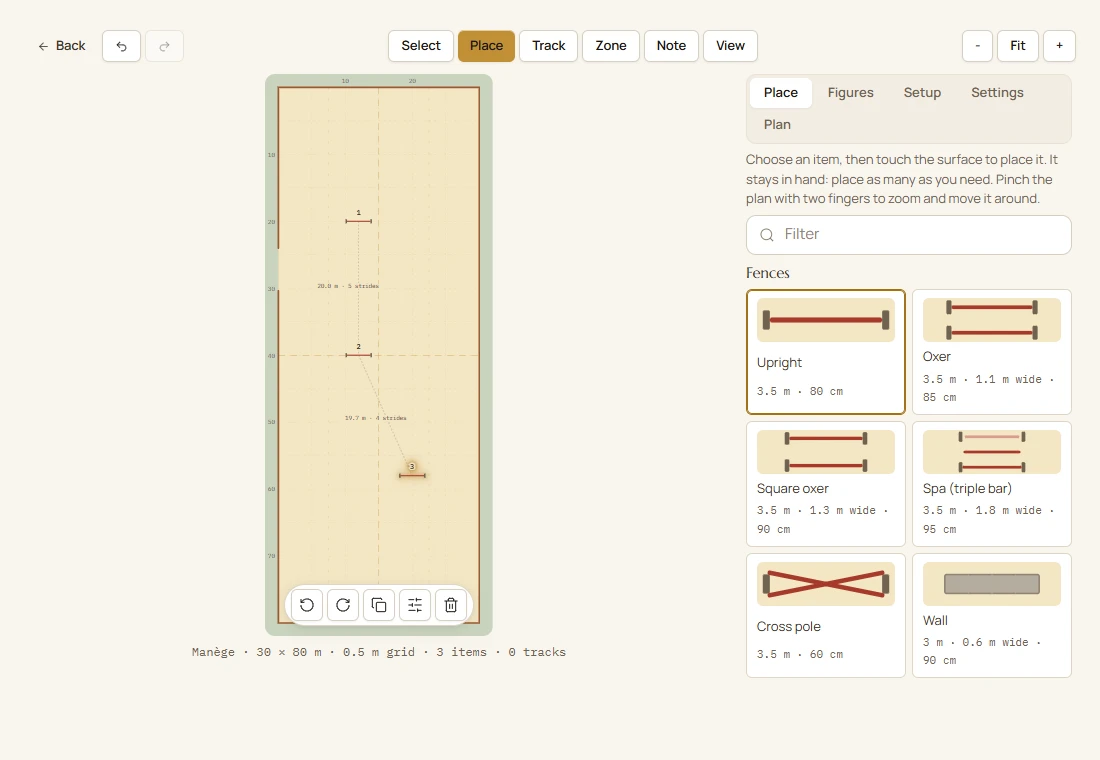
Paddoco's design studio places jumps to the metre on your actual arena plan, calculates distances and displays the strides between them. It is free and opens in a browser.